High Peak Tents vs. Pole Tents: Which Is Right for Your Event?
 Oct 28, 2026|
 View:24
Every event organizer eventually faces the same question: should the outdoor reception use a traditional pole tent or a modern high peak tent? The answer affects how much interior space guests can use, how the structure handles wind and rain, how quickly it goes up, and how the venue looks in photos. This guide compares the two most common event tent styles across structure, space, weather resistance, installation, and cost, so planners can match the right tent to the right occasion.
Key Takeaways
A high peak tent uses an aluminum frame with no center poles, freeing the full floor area for tables, stages, and walkways
Pole tents rely on center poles and perimeter stakes, which typically means lower material cost but reduced usable space and a grass-only installation surface
High peak tents are engineered for wind loads up to 100 km/h and snow loads up to 75 kg/m², with flame-retardant PVC covers meeting DIN4102, B1, and M2 standards
The right event tent choice depends on the venue surface, guest count, weather exposure, and whether the structure will be reused over multiple seasons
What Is a High Peak Tent?
A high peak tent combines the elevated roofline of an A-frame tent with the visual presence of a pagoda tent. Its steep, tall center roof creates a dramatic silhouette while the walls remain straight, which means the peak adds vertical drama without stealing floor space. This makes the high peak tent a common choice for weddings, exhibitions, festivals, and other gatherings where both appearance and usable area matter.
Structurally, high peak tents are frame-supported systems. The roof is carried by an anodized 6061-T6 aluminum frame with galvanized steel connectors, so no interior support poles are needed. The cover is a double-coated PVC membrane weighing 650-850 g/m² that is waterproof, UV-resistant, tear-resistant, and treated with flame-retardant finishes (DIN4102, B1, M2)[2]. Depending on the model, a high peak tent can be specified to withstand wind loads up to 100 km/h and snow loads up to 75 kg/m², and it can be installed on grass, sand, concrete, marble, or other firm surfaces with appropriate anchoring.
Because the sections are modular, high peak tents can be assembled and dismantled with small crews, extended in length to match guest counts, and customized with sidewalls, windows, doors, flooring, lighting, and printed branding. For event planners comparing high peak tent options, these features translate into predictable setup times and flexible layouts.
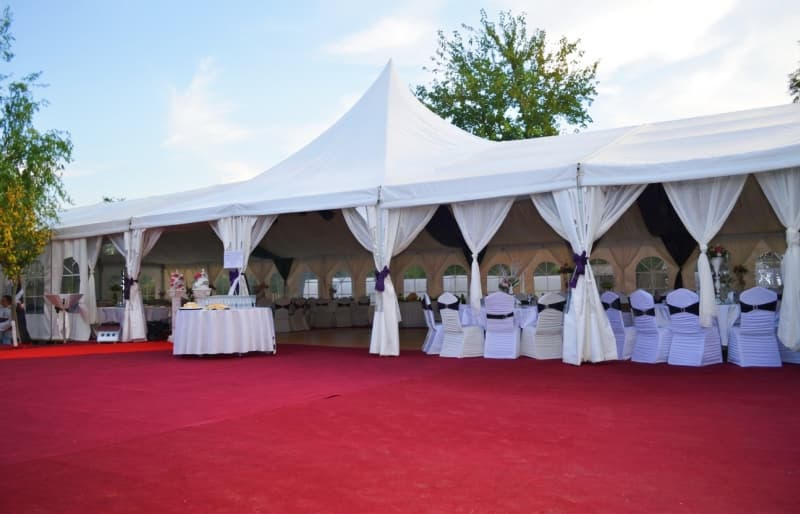
For events that need a striking roofline and an open interior, a frame-supported high peak tent is worth evaluating directly.
High Peak Tent
Meister high peak tent with a 6061-T6 aluminum frame, double-coated flame-retardant PVC cover, and modular lengths. Column-free interior, wind resistance up to 100 km/h, and customizable sizes, colors, windows, and branding for weddings, exhibitions, and festivals.
View ProductWhat Is a Pole Tent?
A pole tent is the traditional marquee style used for decades at garden parties and outdoor weddings. Instead of a self-supporting frame, a pole tent is tensioned between center poles and perimeter poles, with guy ropes and stakes securing the structure to the ground. The steep fabric slopes give the tent its classic peaked look and excellent rainwater runoff.
Pole tents have two practical trade-offs. First, center poles stand inside the occupied space, so seating and staging must be arranged around them, which reduces usable floor area by roughly 10-15% compared with a column-free structure of the same footprint. Second, because the structure depends on staked guy lines for stability, pole tents are typically installed on grass or soft ground; hard surfaces such as concrete or asphalt usually require ballast blocks or a different tent type. In skilled hands, a pole tent can still be set up quickly and at a lower purchase or rental price than an equivalent frame structure, which is why it remains a popular budget option for warm-weather events.
High Peak Tent vs. Pole Tent: Key Differences
The table below summarizes the main differences between the two event tent styles across the factors that matter most to planners.
| Comparison Factor | High Peak Tent | Pole Tent |
|---|---|---|
| Structural support | Self-supporting aluminum frame (6061-T6), galvanized steel connectors | Center poles, perimeter poles, guy ropes, and stakes |
| Interior space | Column-free; full floor area usable for seating and staging | Center poles occupy floor space, limiting layout options |
| Installation surface | Grass, sand, concrete, marble, and other firm ground | Primarily grass or soft ground for stake anchoring |
| Weather resistance | Wind up to 100 km/h; snow up to 75 kg/m²; waterproof, UV-resistant, flame-retardant cover | Good rainwater runoff; stability depends on stake and guy-line condition |
| Cover fabric | Double-coated PVC, 650-850 g/m², DIN4102/B1/M2 flame-retardant | Typically single-layer polyester or vinyl; specification varies by supplier |
| Setup and takedown | Modular sections; small crew; predictable time | Requires experienced crew for tensioning; fast once trained |
| Customization | Lengths, sidewalls, windows, flooring, lighting, printed branding | Limited by pole layout; decor usually added around poles |
| Typical applications | Weddings, exhibitions, festivals, corporate events, seasonal venues | Garden parties, casual weddings, short warm-weather events |
| Relative cost | Higher upfront; long service life with reusable engineered frame | Lower upfront; replacement fabric and hardware over time |
Not Sure Which Event Tent Fits Your Site?
Send your venue surface, guest count, and event date. Meister’s engineers will recommend the right structure and provide a tailored quotation.
Contact UsView High Peak Wedding TentsChoosing the Right Event Tent for Your Occasion
The right event tent balances budget, site conditions, and the experience organizers want guests to remember.
Weddings and Formal Receptions
Wedding planners often prioritize an unobstructed interior, since round tables, a dance floor, and a head table must all fit within the footprint. A high peak tent delivers the elevated silhouette couples expect from a marquee while keeping the entire floor open. For venues on lawn, a pole tent can create a classic garden look, provided the layout works around center poles.
Exhibitions and Corporate Events
Booth layouts and product displays need clear, flexible floor plans. The column-free interior of a frame-supported high peak tent simplifies booth placement and traffic flow. Modular lengths let organizers expand the structure as exhibitor numbers change, and printed branding on sidewalls reinforces sponsor visibility.
Festivals and Community Gatherings
Festivals value structures that install and dismantle quickly between seasons. Both tent types can work, but the high peak tent’s modular frame reduces reliance on ground stakes, making it easier to rotate locations and reuse at different sites.
Long-Term and Permanent Use
For venues planning year-round use, weather resistance and durability become decisive. A high peak tent with a 6061-T6 aluminum frame and 650-850 g/m² double-coated PVC cover is rated for wind loads up to 100 km/h and snow loads up to 75 kg/m², which supports permanent or semi-permanent installation with appropriate anchoring and local engineering review.
Installation, Maintenance, and Safety Considerations
Safe installation starts with site preparation and anchoring. Ground conditions determine the anchoring method: stakes work in grass, while concrete and asphalt typically need expansion bolts, ballast weights, or reinforced guy lines. Planners should review wind safety guidance[1] from the National Weather Service when selecting sites and scheduling setup, and should confirm that fabric covers meet flame-resistant fabric standards (NFPA 701)[2].
For events with large occupant loads, structures should comply with applicable tent and membrane structure requirements, including emergency egress planning and occupancy limits, as outlined in event safety guidelines for tents and membrane structures[3]. Routine maintenance includes cleaning the cover, checking frame connectors and guy lines, and replacing worn hardware; with proper care, a quality aluminum-frame event tent can serve well beyond ten years.
Summary: Matching the Tent to the Event
Both tent types have clear roles. A pole tent offers a classic silhouette and a lower entry price for grass-only, warm-weather events, provided organizers accept center poles and stake-based anchoring. A high peak tent costs more initially but returns a column-free interior, predictable setup, hard-surface compatibility, and engineered wind and snow ratings — advantages that matter for weddings, exhibitions, festivals, and long-term venues.
Planners should compare the two styles against their venue surface, guest count, weather exposure, and reuse plans before deciding. When the decision points toward a high peak tent, buyers can evaluate manufacturers on engineering documentation, material certifications, customization capability, and service support.
Looking for a Reliable High Peak Tent Manufacturer?
For a dependable high peak tent manufacturer with 12+ years of structural tent experience and delivery to 100+ countries, contact Meister for specifications, certifications, and pricing.
Contact UsView All ProductsFrequently Asked Questions
What is the main difference between a high peak tent and a pole tent?
The main difference is structural support. A high peak tent uses a self-supporting aluminum frame with no center poles, so the entire floor area is usable. A pole tent uses center poles, perimeter poles, and guy ropes, which cost less but reduce usable space and require grass or soft ground for staking.
Which tent provides more usable interior space for a wedding?
A high peak tent provides more usable space because its column-free interior lets round tables, a dance floor, and a head table be arranged without working around center poles. For the same footprint, pole tents lose roughly 10-15% of usable area to center pole placement.
Are high peak tents suitable for outdoor events in windy regions?
Yes, when properly anchored. Quality high peak tents are engineered for wind loads up to 100 km/h and snow loads up to 75 kg/m², and the double-coated PVC cover is waterproof, UV-resistant, and tear-resistant. Anchoring method and local engineering review still determine safety on any given site.
How long does it take to install a high peak tent?
Setup time depends on tent size and crew size, but modular high peak tents are typically assembled within a few hours by a trained crew. Frame sections, roof panels, and sidewalls connect in a repeatable sequence, which makes takedown and relocation predictable.
What materials are used in a high peak tent?
High peak tents are typically built with an anodized 6061-T6 aluminum frame, galvanized steel connectors, and a double-coated PVC cover weighing 650-850 g/m². The cover is flame-retardant to DIN4102, B1, and M2 standards, waterproof, UV-resistant, and self-cleaning.
What should buyers consider when choosing a high peak tent manufacturer?
Buyers should review engineering documentation, wind and snow load ratings, fabric certifications (such as NFPA 701 or DIN4102), customization options, installation support, and warranty terms. Manufacturers should also provide project references and clear delivery timelines.
Sources & References
National Weather Service – Wind Safety: https://www.weather.gov/safety/wind
NFPA – NFPA 701: Standard Methods of Fire Tests for Flame Propagation of Textiles and Films: https://www.nfpa.org/codes-and-standards/all-codes-and-standards/list-of-codes-and-standards/detail?code=701
NFPA – NFPA 102: Standard for Grandstands, Folding and Telescopic Seating, Tents, and Membrane Structures: https://www.nfpa.org/codes-and-standards/all-codes-and-standards/list-of-codes-and-standards/detail?code=102
Note: Pole tent space-loss estimates (10-15%) and typical applications reflect commonly cited industry figures for tensioned pole structures; actual performance varies by manufacturer and site conditions.